Flat Roof Ponding & Metal Resealing Knoxville, TN
Engineered flat roof drainage solutions, commercial membrane seam repair, and Metal Roof Screw Back-Out Resealing across Knoxville and East Tennessee.
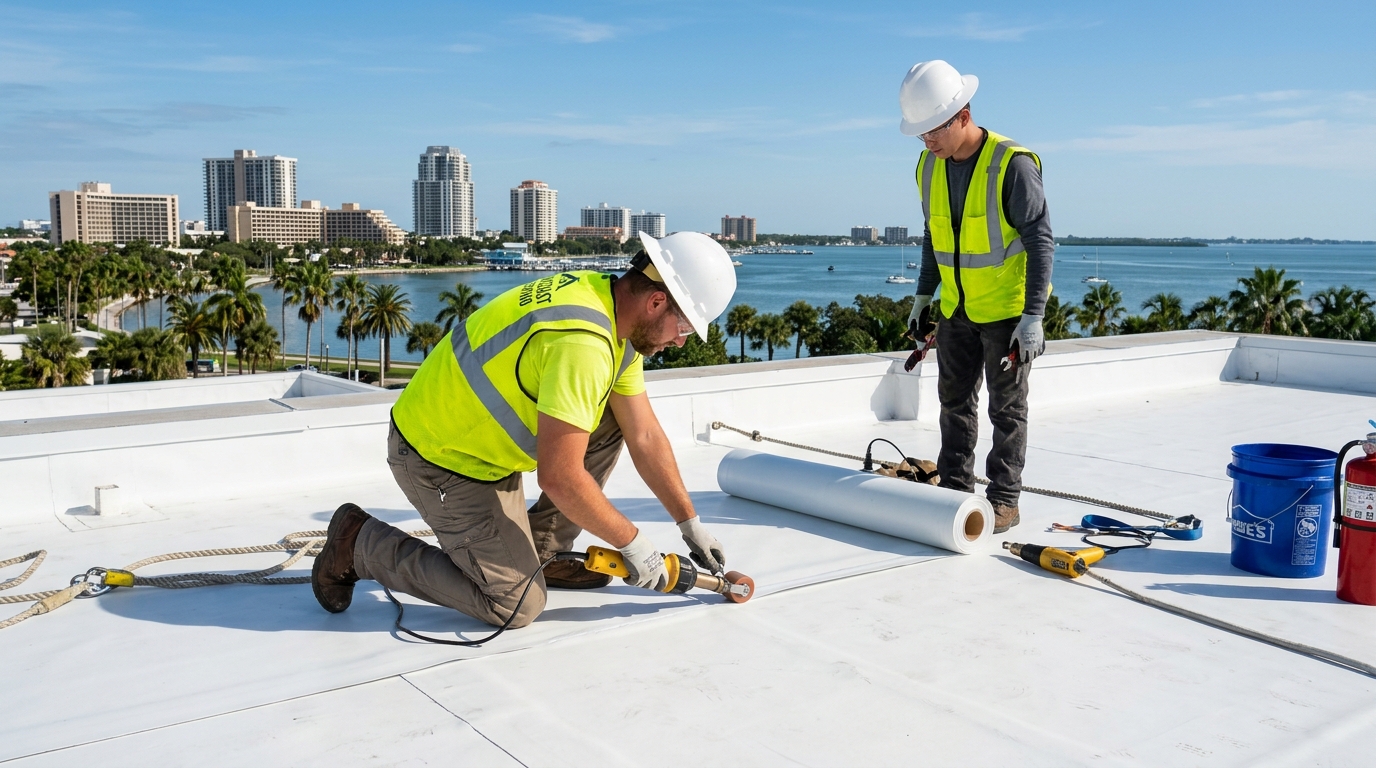
Flat Roof Ponding Water Remediation, Membrane Seams & Metal Resealing
Low-slope and flat roofing systems on commercial establishments, multi-family complexes, and residential modern additions throughout Knoxville face severe challenges from standing water. According to the National Roofing Contractors Association (NRCA), ponding water is defined as standing water that remains on a roof surface 48 hours or longer following precipitation. In East Tennessee's humid climate, persistent ponding accelerates membrane degradation, promotes biological moss and algae accumulation, and exerts massive hydrostatic load on roof deck framing.
Furthermore, metal commercial and agricultural buildings across Knox County frequently suffer from fastener back-out. This service specialty integrates complete Metal Roof Screw Back-Out Resealing, addressing backed-out fasteners, deteriorated neoprene washers, and thermal movement gaps across standing seam and corrugated metal assemblies.
Key Technical Engineering Protocols:
- TPO/EPDM Seam Welding: Inspecting and hot-air welding delaminated thermoplastic polyolefin (TPO) laps and re-priming ethylene propylene diene monomer (EPDM) seam tape joints.
- Metal Roof Screw Back-Out Resealing: Extracting loosened fasteners, inspecting wood and purlin substrates, and driving oversized self-tapping screws with vulcanized EPDM washers to calibrated torque.
- Scupper & Downspout Clearing: Clearing clogged exterior scuppers, interior roof drains, and overflow relief drains that cause dangerous water retention.
- Tapered Cricket Sump Installation: Adding polyisocyanurate (polyiso) tapered insulation saddles to redirect standing water toward functional drainage points.
- Substrate Core Sampling: Non-destructive infrared thermography identifies trapped subsurface insulation moisture, preventing extensive deck structural rot.
Commercial & Residential Low-Slope Systems
Whether managing a commercial retail property in Downtown Knoxville or a residential flat roof patio in Oak Ridge, persistent ponding water indicates structural deflection or improper drainage engineering. Dispatched independent contractors provide targeted mechanical remediation, eliminating chronic standing water and extending the operational life of your roof.
Knoxville Basin Microclimate, Mountain Gale Uplift & Moisture Dynamics
1. Regional Microclimate Dynamics & Severe Mountain Wind Exposure
The City of Knoxville and the broader East Tennessee Valley occupy a geographically complex corridor bounded by the Cumberland Plateau to the northwest and the Great Smoky Mountains to the southeast. This unique topography creates severe wind-shear funnels and rapid barometric pressure swings when convective storm systems sweep eastward across Tennessee. Mountain winds descending off higher elevations frequently produce localized gale-force gusts exceeding 55 to 70 miles per hour, generating intense negative atmospheric pressure across windward roof eaves, leeward ridge vents, and gables.
During late spring and summer thunderstorm fronts, orographic uplift triggers severe hail cells that strike Knox, Blount, and Anderson Counties with dense, hard-frozen hail cores. Concurrently, valley rains deliver sustained, high-volume downpours that inundate structural valleys, chimney crickets, and low-slope transitions. When mountain winds compromise asphalt shingle adhesive seals or back out fasteners on exposed-fastener metal roofing, rainwater is driven horizontally beneath underlayments, infiltrating roof decking, attic insulation, and residential ceilings within minutes of storm onset.
2. Non-Destructive Moisture Diagnostics & FLIR Thermal Tracing
Accurate roof leak repair in East Tennessee requires advanced non-destructive moisture detection to identify water pathways that remain hidden behind interior drywall and attic insulation. Water that penetrates at an elevated ridge vent or deteriorated chimney flashing frequently travels down structural rafters, purlins, or conduit runs, depositing moisture dozens of feet away from the initial exterior breach. Dispatched emergency diagnostic technicians employ high-resolution calibrated FLIR thermal imaging cameras to identify subtle evaporative cooling differentials across ceiling drywall, roof decking, and rafter cavities.
Thermographic mapping is verified using non-penetrating radio-frequency moisture meters and deep-pin electronic resistance sensors. By evaluating moisture content within oriented strand board (OSB) and dimensional tongue-and-groove pine decking, technicians verify whether substrate framing has sustained fungal rot, delamination, or structural deflection. This non-invasive diagnostic protocol ensures that emergency containment and subsequent permanent repair scopes resolve root failure points rather than masking symptomatic water staining.
3. Step-by-Step Substrate Restoration Methodology
Professional roofing remediation demands precise mechanical execution tailored to the specific substrate material and environmental stressor:
Three Mandatory East Tennessee Restoration Specialties:
- Mountain Gale Shingle Lift Repair: High-velocity mountain wind uplift breaks thermal seal strips and tears nail heads through aged shingle mats. Restoration involves carefully loosening bonded shingle courses above damaged rows, extracting bent or overdriven pneumatic fasteners, inspecting underlying synthetic underlayment, and hand-tabbing new Class F/H wind-rated fiberglass architectural shingles with high-performance elastomeric asphalt adhesive beads and ring-shank corrosion-resistant hot-dipped galvanized nails driven flush at manufacturer-specified nailing zones.
- Metal Roof Screw Back-Out Resealing: Exposed-fastener standing seam and corrugated metal agricultural panels common across East Tennessee experience continuous thermal expansion and contraction cycles. Over time, wood purlin shrinkage backs out hex-head screws, degrading EPDM rubber sealing washers and allowing water seepage down fastener threads. Remediation involves removing deteriorated screws, inspecting wood purlin integrity, boring oversize pilot holes where necessary, and driving oversized #12 or #14 self-tapping galvanized screws equipped with vulcanized UV-resistant EPDM bonded washers to a calibrated torque tension.
- Chimney Step Flashing Seal: Mountain valley winds drive heavy rain horizontally against massive brick and stone chimney assemblies. Counterflashing mortar joints crack from seismic or thermal settling, while base step flashing pieces corrode. Remediation involves cutting out cracked mortar joints to a depth of 1 inch using diamond tuckpoint blades, inspecting chimney cricket diversion valleys, installing 26-gauge galvanized or copper step flashing woven into each shingle course with 2-inch headlaps, and embedding heavy-gauge lead or aluminum counterflashing anchored with mechanical lead expansion plugs and polyurethane masonry joint sealants.
4. Tennessee Building Codes & Independent Contractor Licensing Compliance
Roofing remediation in the City of Knoxville, Knox County, and neighboring East Tennessee municipalities must comply with the 2018/2021 International Residential Code (IRC) and International Building Code (IBC) as adopted with local municipal amendments. Tennessee law strictly governs contractor qualifications: under Tennessee Code Annotated (T.C.A. § 62-6-102), any roofing or construction project where the contract value equals or exceeds \,000 requires a licensed General Contractor with a Home Improvement (HI) or Commercial/Residential Roofing specialty license issued by the Tennessee Board for Licensing Contractors.
For projects under \,000, contractors must maintain active county business licenses, local municipal permits, and comprehensive commercial general liability insurance along with statutory workers' compensation coverage. Furthermore, energy conservation codes require specified continuous attic ventilation calculations (1 sq. ft. net free area per 300 sq. ft. of attic floor when balanced with continuous soffit intake and ridge exhaust) and ice-barrier self-adhering polymer-modified bitumen membrane installation at all critical eaves, valleys, and wall junctions. Dispatched independent roofing contractors maintain verified compliance with Tennessee Department of Commerce and Insurance (TDCI) standards.
5. Preventative Property Maintenance & Great Smoky Mountain Foothills Storm Preparedness
Proactive seasonal roof maintenance significantly reduces catastrophic water damage during severe Appalachian weather events. East Tennessee property owners should establish bi-annual roof inspections each spring before convective hail cycles and each autumn following heavy hardwood leaf drop. Heavy pine needles, oak leaves, and hemlock debris accumulate rapidly in roof valleys, gutter troughs, and behind chimney crickets, forming organic moisture dams that accelerate asphalt shingle rot and sheet-metal corrosion.
Trimming overhanging tree limbs back at least 10 to 15 feet from roof planes prevents limb impact punctures and reduces abrasive moss growth caused by chronic shade. Inspecting rubber pipe boot collars for ultraviolet embrittlement and resealing flashing lap seams ensures watertight integrity prior to seasonal winter freezes and heavy spring thunderstorms. When emergency roof damage occurs, calling our 24/7 Knoxville dispatch desk connects property owners with on-call repair crews who implement rapid emergency tarping and engineered restoration.
Frequently Asked Questions • Knoxville Emergency Roof Repair
How does ponding water damage a flat roof?
Ponding water acts as a magnifying lens for UV rays, accelerating chemical breakdown of asphalt and rubber membranes. It also adds immense weight, flexing roof decking and pulling open lap seams.
What causes metal roof screws to back out on East Tennessee buildings?
Thermal expansion and contraction from hot summers and cold winters causes metal panels to shift slightly every day, slowly backing out wood screws and degrading the rubber washer.
Can a ponding water area be repaired without replacing the whole flat roof?
Yes. Technicians can install tapered insulation sumps, reinforce failing seams with commercial elastomeric coatings, and clear drainage scuppers to eliminate localized water pooling.